
The day has arrived, it’s July 12th of 2019, i’m 23 years old, all my belongings have been crammed into one big suitcase and I head off for the most terrifying and wonderful adventure of my life to date – Moving from Australia to Portugal. Prior to this, I’d been to Portugal only once for 5 weeks, in April of 2018. When I was a tourist in Portugal I had studied up on a couple useful Portuguese phrases to get me by, but to my surprise, I almost never used any of them besides hello, thank you and goodbye. The Portuguese in general, are known to be quite skilled in English, even if not at an advanced level. Mostly every Portuguese person I had come across on that first trip, both young and old, spoke a decent amount of English. Now I know I was in the very touristy capital Lisbon, however I didn’t always feel this same way in other big European capitals. I’d say this is a testament to what I consider the Portuguese qualities of hospitality, a high-level of tolerance and kindness. However I am a firm believer in making the effort to learn and speak at least some of the language of the country one is visiting. For me it goes beyond respect and politeness, I think it’s the ultimate way of appreciating and understanding the people and their culture. Language is more than just words put together, it’s an entire interwoven universe of its own, overflowing with beauty and history and so much more.
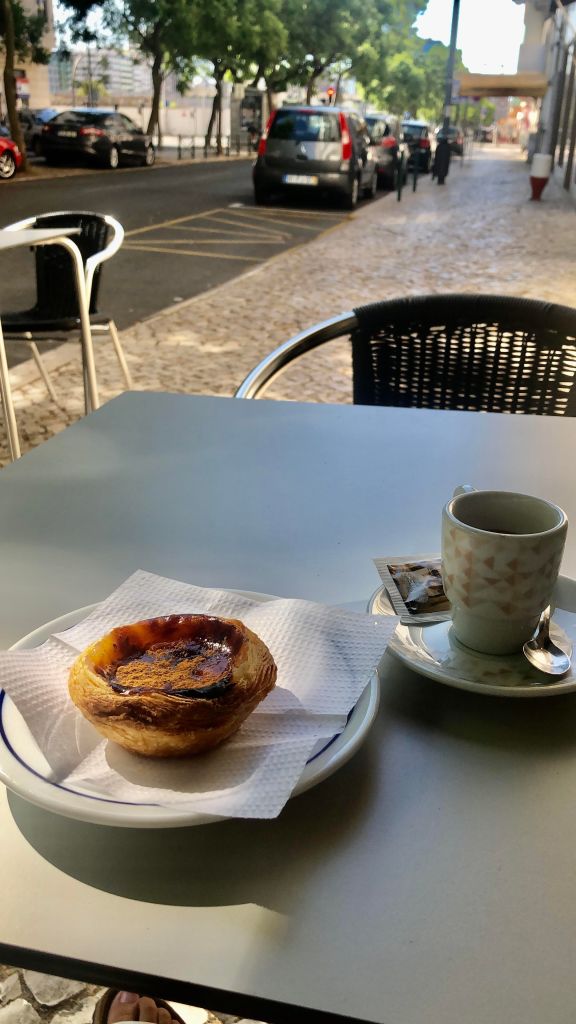
Well then, in preparation for my big move, I hired a Portuguese teacher in Sydney and had several lessons leading up to my relocation. My main objective was to have the basic vocabulary to get by as I settled into my new home. I was still a beginner when I moved here in 2019, but I was confident that i’d pick it up quickly and be on my way to fluency soon enough. So at last I arrive in beautiful Lisbon, and spend the first day recovering from the tedious but exciting 28 hour journey and accompanying jetlag. The next morning, I jump out of bed and head to the local neighborhood café to get myself a coffee and a divine Portuguese egg tart, known here as a pastel de nata (if you haven’t tried one, please for the love of God, do). There I am, prancing down the main street, rehearsing what I’d say (in Portuguese) when I get into the café. Feeling a little nervous but telling myself “you’ve got this” several times over. I find a café that looks lovely and warily tread inside.I know exactly what I want so I don’t take long before it’s lights, camera, action. I go to open my mouth – nothingness. My mouth is a vacuum, just one big empty void. All of a sudden every Portuguese word I thought I had nicely stored inside my memory has vanished. I resort to English, the waitress knows almost none but understands me nonetheless thanks to some finger pointing and head nodding. I find the most hidden-away table possible and sit down in a defeated slump. The self-criticism doesn’t take long before it paralyzes me, so I scoff down the coffee and tart and run out of there in lightning speed.
This doesn’t turn out to be the last of these types of occurrences for me, but eventually it does get better, a lot better. At first I steered clear of those situations in which I would have to speak Portuguese, so I frequented cafés that I knew were owned by English-speaking people, which sometimes made life harder because I had to go out of my way just for a coffee. If I did go to a typical Portuguese café but saw that it was full of people, I’d also avoid it so that nobody had to hear me stutter and choke and make a fool of myself trying to speak their language. God forbid I wasted someones time or was the center of attention for a minute. I avoided taking consistent Portuguese classes because I felt that no matter what I did, I just wouldn’t be able to speak well and just kept telling myself that eventually i’d pick it up. Turns out it’s hard to pick up a language that you avoid speaking at all costs. I started working full time as an English teacher and so again, days and weeks and months went by with very little Portuguese practice. My conversations at supermarkets, cafés etc were brief and fleeting, which didn’t feel great. I’m a person who has always loved making small talk with the shop assistant, asking them what they think of the dress or how their day was going. I used to enjoy bumping into a neighbor, commenting on the weather and wishing them a good day. I didn’t do any of this anymore, I felt I just wasn’t able to and that it was safer to keep quiet and carry on being invisible. I also had my Portuguese partner with me in a lot of situations which helped me on my mission of avoiding Portuguese. If I had to go somewhere alone, like the doctor’s office, I’d start every encounter by asking if they spoke English. I was in luck many, many times. Even though I was getting by this way, I started to feel quite unfulfilled, lonely and embarrassed over time.
In hindsight, this all seems ludicrous and I do think I was being absurd and limiting myself from experiencing more beauty and meaning, but hey, it’s not easy. So now I find myself being compassionate to that very nervous, shy and awkward girl. Fast forward almost 2 years, and here I am, still in Lisbon, but a very different girl. Still nervous, still shy and still awkward, but with an emerging streak of confidence and composure. A couple of weeks ago I spent 20 minutes at the post office sorting out an international parcel I was sending my brother, and I did it all in Portuguese. A few days ago I had a lengthy conversation with a stationary shop employee about notebooks, in Portuguese. For an outsider this might seem trivial or obvious – who cares? anyone would learn some Portuguese eventually after 2 years. But for me, it’s one of the greatest achievements of my life thus far. Because every time I tiptoed into a café, my knees were trembling and my hands were sweaty, but I did it anyway. Each time it was hard, but each time it got a little bit easier.
And so, I learnt that nobody is really that impressed with a perfect sentence without errors, people just want to know you care. I learnt that it was much better to ask my neighbor about her day and say it imperfectly, than to pass her by with a smile and a sad heaviness in my throat. Further, it all made me more compassionate, patient and understanding as an English teacher but also just as a human being. It reminded me of the notion that we never know how much a person is struggling, and that in general, people prefer authentic not perfect. There’s no need to make yourself invisible just because you don’t know something well enough.
I think this simple yet powerful philosophy can apply to almost any skill, not just language learning. Just show up. Even when it’s scary and hard. Because your presence matters, no matter how imperfect it may be.




 ANGELICA G WRITES
Leave a comment